| rosanista.com | ||
| Simplified Scientific Christianity |
It has often been said that the origins of the Round Table are lost amid the shadows of antiquity. It is well known that the earliest tournaments of medieval times were sometimes referred to as "round tables."
A late representation of Arthur's Round Table consists of twenty-four alternating white and green bands, in the center of which is emblazoned a large red rose in whose heart appears a half-opened rose of pearly white. Historians assure us that this particular table — which hangs in Winchester Castle — originates with the Tudor kings, whose colors were red and white, harmonizing the conflicting loyalties of the formerly warring houses of Lancaster and York. But the soteric Christian understands that the red and white roses have always borne an important symbolism in the spiritual life of mystic and occultist alike. In the early days of the Christian community, each aspirant was taught that he must come to change the passion-filled blood into the purity and high spiritual attainment, typified by the rose, both red and white; just as we saw that the spire of the Gothic Grail Castle was tipped with a blazing ruby surmounted by a crystal cross.
Arthur's seat was at the head of the Table, and it is said that the King founded the Round Table so "that when his fair fellowship sat to meat, their chairs should be high alike; their services equal, and none before or after his comrade." It is an early legend which says that the Table was made in likeness of the Table used at the Last Supper. The seats which surrounded the Table were thirteen in number, a numerical pattern of significance. Twelve only of these seats could be occupied, and they only by knights of the highest fame; the thirteenth represented the seat of the traitor Judas. It remained always empty. It was called the Perilous Seat, since the time when a rash and haughty Saracen knight had dared to seat himself in it and the earth had opened and swallowed him up.
A magic power wrote upon each seat the name of the knight who was entitled to sit in it. None could succeed to a vacant chair unless he surpassed in valor and glorious deeds the knight who had occupied it before him; lacking this qualification he would be violently repulsed by a hidden force. Thus proof was made of all those who presented themselves to replace the Companions of the Order who had fallen.
Esoterically, this means that every aspirant to spiritual unfold ment is tested and tried before being given the instruction that will unfold his latent, but ripening, powers. Not the Order, or members of the Order, forbid any candidate from assuming a place, but the hidden, titanic forces of his own character forcibly eject him from the midst of spiritual Mysteries for which he is not yet ready or "ripened."
The Seige Perilous, the most dangerous because the focus of the most powerful cosmic forces is for the purest and strongest. It typifies that straight and narrow Path which many search for but few find, and of those who find, how few follow to its end! The Seige Perilous therefore remains vacant awaiting the coming of the knight who, in the words of St. Paul, has finished the course, has kept faith. This perfect knight is represented in the Arthurian legends by Sir Galahad, who when he first dedicated himself to the Seige Perilous, said: "It is here that I must renounce all things in order that I may gain all." In these words Galahad gave utterance to one of the fundamental maxims of occultism.
When Galahad had triumphed spiritually his name flashed in golden light across the vacant chair, and the angels sang triumphantly above it, joyously proclaiming that Galahad had been found worthy to be numbered among the Companions. The peace, reverence and beauty which permeate the atmosphere of the Mystery School are congenial to the visits of angelic servitors who come and go in the holy environs in the course of their earth ministrations; for in such places there is a vortex of force, with quietness at its center, which joins heaven and earth, making possible continuous intercommunication between men and angels.
White and green were the heraldic colors of King Arthur. These are the true Life colors, and they are the colors of the exalted Hierarchy of celestial beings who work through the forces of the sign Cancer, the sign of the Celestial Madonna, the Cosmic Mother. Throughout the Mystery literature of antiquity we come upon references to the Sacred Green, which, while notable in Druidic Mysteries, goes back also into the early roots of Esoteric Christianity as it came out of Egypt and the East.
The aspirant in every Mystery School, whether this school be of the Orient or the Occident —there are seven of these Schools in all, each one teaching the Nine Lesser Mysteries — must learn the basic lesson of purity and harmlessness. These are the prerequisites to all true enlightenment. The body must be sustained with pure foods, the mind with pure thoughts, and the life filled with high unselfish deeds. Such were the preparatory steps which led the Grail Knight to King Arthur's Court and to a predestined seat at the Table Round. The vow with which the knight made his allegiance was in substance as follows: "Think pure, speak true, right wrongs, live in fellowship — love only one maiden and cleave to her so long as life shall last."
But the years of preparation leading to this much-sought goal were years of trial, of hardship, of prolonged and dedicated labor of body and mind and soul. While the pattern is that which is usual to the time and the civilization in which the feudal institutions dominated Europe, there is discernible throughout a parallel with the actual occult development of the human being, not only as from childhood to adulthood but also as from spiritual incapacity to spiritual power and understanding. There is evidence here of a profound wisdom which continued to assert its power in the lives of the people, even when it had been driven underground by the aggression of self-seeking States and the Church.
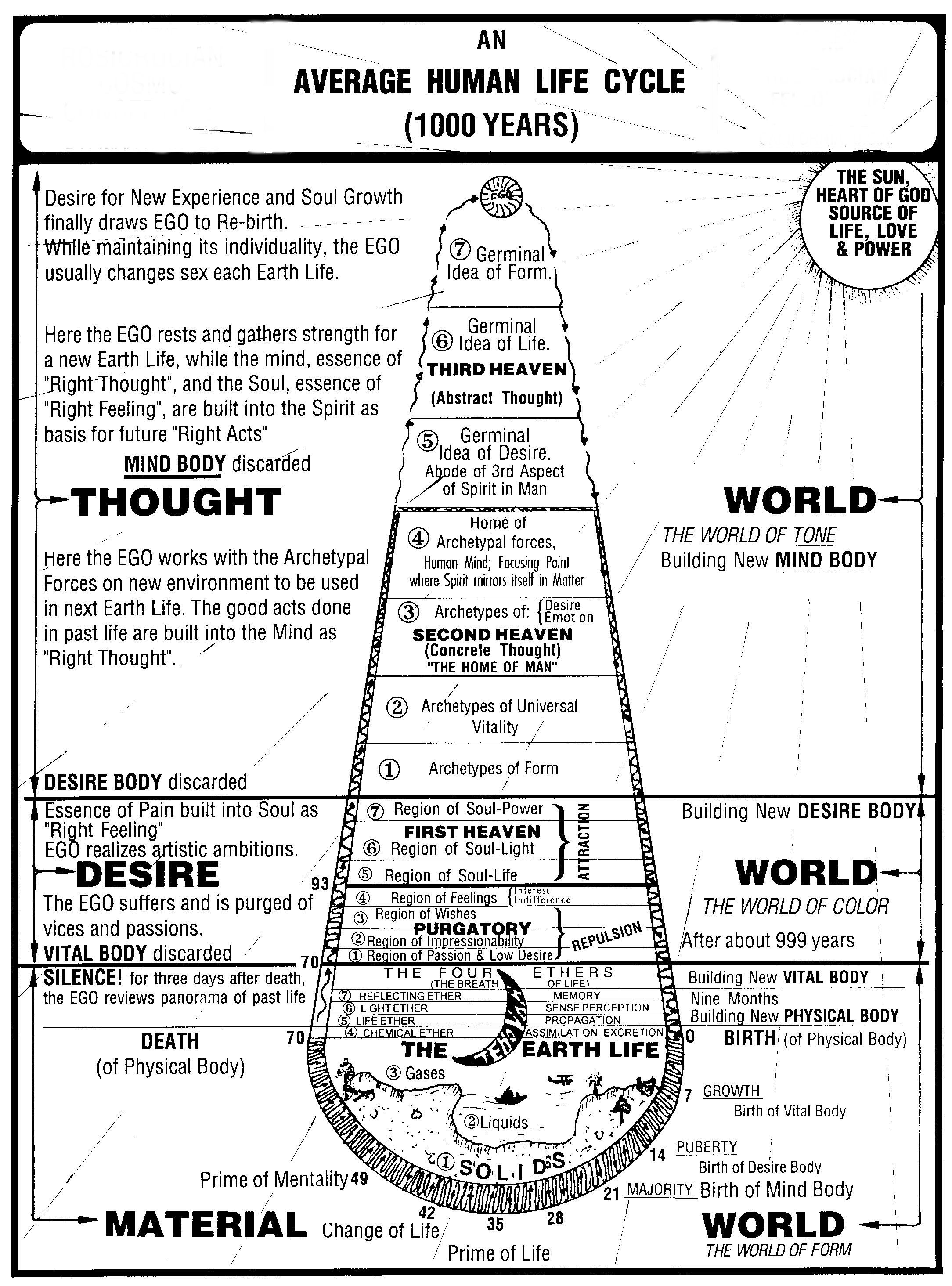
In all Mystery Schools occult anatomy has been an important part of Temple teachings, for there the biblical statement, "Ye are the temple of the living God," is taken literally and observed re ligiously. Every aspirant has been taught to reverence his physical temple and to endeavor to make it a more fitting and responsive instrument for the use of the divine spirit dwelling within it. The life of the body proceeds in seven-year terms, with certain qualities and powers maturing within each period, and with each stage overlapping and complementing and stimulating the growth of the next. The seventh period of growth ends with the forty-ninth year, which concludes the normal course of karmic indebtedness from past incarnations on earth; with the fiftieth year the ego enters upon a period in which, in a special sense, he is instituting new causation, destined to mature in future lives, while extracting the essence of the karma of the life now drawing to a close. This, at least, is true of the spiritually awakened ego; although for the ego which is still in bondage to the flesh, the declining years of an incarnation merely lead to deeper and deeper sleep, which ends in death.
The secret Wisdom which still operated in medieval Europe through initiated singers and teachers led to a plan of life which to a degree paralleled the real, occult growth of the human personality from stage to stage in its septenary cycles.
At the age of seven the sons of nobles who were found to be amenable to knightly training were taken from the homes of their parents and placed in the care of certain Preceptor-Knights. These Preceptor-Knights were noblemen who turned over their great castles and estates to be used as training schools for young knights. Here they underwent strenuous physical training and were taught moral precepts having their foundation in deep spirituality. The first or infant stage was that of Knave, during which the boy was taught to serve in kitchens; the next was Page (seven to fourteen) when he was taught to wait upon the tables and to perform other menial duties which were, however, less menial than those of the Knave.
All this so that they might learn true humility of spirit and the real joy of simplicity in everyday living, as well as to understand how to deal with their own servitors in the years to come.
During their leisure hours the young pages were taught to dance and to play upon the harp, and they learned many other graceful and courtly accomplishments.
It is to be noted that among their more serious studies was an investigation of the mysteries of the forests and streams. The exoteric historian looks upon this as mere excursions in hunting and fishing, and so it was with those who were ready for nothing more. But for the gentle and intelligent lads who showed to the eye of the spiritual Master an aptitude for wisdom, there was something deeper. For in the depths of the dense forests which covered Europe in the Middle Ages there still dwelt certain Masters of the suppressed Wisdom; and to these the superior lads were taken for instruction. These Masters and their Schools were not in all instances "pagans" or "heathens" — but in the eyes of Rome they were assuredly "heretics." How frequently one finds that a Grail hero seeks out, or is sought out, by a "Hermit" dwelling in a wood, who instructs him in heavenly wisdom!
Thus certain favored youths learned to know the various ranks of nature spirits, and the times to invoke the lordly angels, and how the interior eye was to be awakened, what herbs were useful in healing and what was to be learned from their "younger brothers" of sky and forest and stream who "talked" to them and instructed them in the mysteries of divination.
The many "enchanters"· who are described in the various knightly legends as possessing superhuman powers which they used for good or ill, as the case might be, represent those persons who by reason of their clairvoyant powers were able to communicate with the nature spirits, the invisible denizens of woodland and field, and thus to direct the course of nature. Both King Arthur and the magician Merlin possessed these powers, which enabled them to live not merely as men among men but as spirits among spiritual beings.
At the age of fourteen the Page became the Esquire. Here his training became strenuous and his duties arduous. He was taught to run foot races, to leap great ditches, scale high walls, to fence, and to vault both on and off a horse while wearing heavy armor; and certain duties were laid upon him to test his integrity and intelligence.
In all of the training castles for the young knights there dwelt many beautiful young maidens under instruction by the Lady of the castle, and each Esquire was encouraged to choose one to be the mistress of his heart, upon whom to bestow all the graceful knightly courtesies which the Lady taught him. For this was the province of the Lady, as the feats of arms and skill in statecraft were the province of the Master-Knight. Hence it was that love, constancy and a high ideal of womanhood were taught as an essential part of the early training in the ways of knighthood.
The young Esquire's proficiency in all manner of graceful horsemanship was continued together with instruction in the social arts of dancing and harp-playing and conversation. He now also learned to sing many of the beautiful ballads which had been composed by the earliest troubadours.
At the age of twenty-one the knightly instruction — physical, moral and mental — was thought to be complete, and the young man was now ready to receive the initiation of knighthood. The preparation for this initiation was solemn and reverent. Many days were spent in fasting and many nights in long vigils of prayer. At length the prospective Knight received the Sacrament, together with the blessing of the priest, at which time also a special blessing and dedication of his sword was made, that it might be used always and only to serve high and noble purposes.
Then the young Knight — or neophyte, in the spiritual sense-was robed in garments of pure white, and brought into the presence of his Preceptor-Knight. This ceremony took place either in a church or in the private chapel of the castle where the training took place. Here, as the young man knelt before the Preceptor-Knight, he was questioned as to his ideals and purposes in assuming knighthood. If the answers proved satisfactory to the presiding Knight, the various articles which constituted the knightly equipment, which were generally in the possession of his chosen maiden, were now presented to him. Among these were the shield, the helmet, the gauntlet and the visor, the spurs and the coat of mail. Last he received his dedicated sword. He then knelt again before the presiding Knight, who gave him the accolade, consisting of three strokes with the flat of a sword — one upon each shoulder and one upon the neck, accompanied by the words: "In the name of God, of St. Michael and St. George, I make thee a knight; be valiant, courteous and loyal!" Then he received his helmet, his shield and spear, and thus the investiture ended.
The years of training for knighthood were complete, and the young knight was now ready to go forth into the world, into adventurous years filled with chivalry, roseate with dreams of romance, yet withal imbued with high spiritual intent and purpose.
— Corinne Heline
|

|
|
|
|
Contemporary Mystic Christianity |
|
This web page has been edited and/or excerpted from reference material, has been modified from its original version, and is in conformance with the web host's Members Terms & Conditions. This website is offered to the public by students of The Rosicrucian Teachings, and has no official affiliation with any organization. | Mobile Version | |
|