| rosanista.com | ||
| Simplified Scientific Christianity |
Galahad came to Camelot at a time when the glory of King Arthur's Court was already drawing to a close. The youngest knight in the fellowship, for he was still a youth when knighted by the King, he was second to none in knightly prowess; even Sir Lancelot took no precedence over him either in feats of skill or strength.
Galahad, in the Vulgate, is the name of the great-grandson of Joseph, and is the same as Gilead, Numbers 26:29; Judges 10:18.
His lineage is obscure on his father's side; but through his mother he descends from "the first Bishop in Christendom," Joseph of Arimathea. A legend states that Galahad's father was "a fiend" who attacked a holy nun, that the infant of this union was taken by the convent and reared to young manhood until the time to send him to King Arthur's Court. Another legend has it that Sir Lancelot was his father and Elaine, daughter of King Pelles of the Castle Carbonek, was his mother, and that he showed the heredity from both, the knightly powers of his father and the saintliness of his mother. A third account identifies him with the Parsifal of German legend, or the Percival of the English cycle. Sir Arthur malory separates these accounts in his Morte d' Arthur, but it is possible to weave the Percival-Galahad cycles into one connected narrative; and while this lacks the studied and polished spirituality of the popular accounts, most notably that which Tennyson developed in The Idyll of the King, the esoteric significance emerges even more clearly.
However, the Galahad cycle as popularized by Tennyson and the Parsifal cycle as popularized by Wagner contain all of the essential esotericisms of the originals; and since these accounts are readily obtainable, we have chosen to follow them in the main features while adding such points from other sources as may throw added light upon the Grail Mysteries.
Those who are appointed "Ambassadors of Spirit" appear to have, even from infancy, some recognition of what their destiny is to he, and they begin early to prepare for this destiny, in childhood, almost as if with conscious deliberation.
The Abbey mural shows the infant Galahad clasping his hands together, gazing in rapt adoration at something invisible to those around him, while an expression of bliss overspreads his child's countenance. The nuns who have him in charge gaze upon him in awe, for they know that he sees what they cannot see, and hears what they cannot hear, of sights and sounds from angelic worlds. These nuns are no less than virgin servitors of the Grail attached to the Grail Castle Carbonek.
Galahad was still scarce more than a child — a youth of fifteen winters or thereabout-when he came to Arthur's Court. Such precocity is not unusual among old souls, for at this age, when other youths first feel the strong stirring of worldly ambitions and desires, the old soul experiences the remembered urge toward the things of Spirit. History affords many examples of this, from the boy Christ disputing in the Temple with the doctors to Joan of Arc leading her armies in battle.
There was great rejoicing throughout Camelot on the day that Galahad came to Arthur's Court. His coming was announced by marvels. On the river a red stone floated, in whi';h. by some miraculous means a sword was deeply thrust, arid on its pommel were inscribed these words: "No man shall take me hence but he by whose side I should hang, and he shall be the best knight in the world." Seeing which, the King said to Lancelot, "Thou art the best knight, Lancelot," but Lancelot would not touch the sword, declaring that Merlin had prophesied that these marvels should come to pass in the day when the Sangreal was to be again manifest among men, and that whosoever touched the sword would suffer death by it, unless it were the knight to whom it rightfully belonged; and, he said, that knight was not himself.
Therefore the King and his knights returned to the great hall, and each knight sat down in his own place, and the banquet was begun with laughter and good fellowship, when of a sudden the doors and windows shut themselves, and the hall was in deep darkness, and no one in the hall dared move or make a sound. Then came a light which hovered over the Seige Perilous, where knight had never sat, and in the ghostly radiance each saw the face of his fellows looking one to another with awe and amaze.
And King Arthur arose from his seat at the high place of the circle and said: "Lords and fair knights, have no fear; we have seen strange things today, but stranger things are to come. Now I know that today we will see him who is to have the Seige Perilous and shall achieve the Holy Grail, which has been lost since Balin struck King Pelles; yet now it may be left to this noble Order to bring it to the land again. But only he may attain this Quest who hath clean hands and a pure heart, and valor and hardihood, beyond other men."
He had not finished speaking before the outer door opened and there entered into the hall an old man robed all in white, with his head concealed, leading by the hand a youth clad all in red, wearing no armor, and carrying neither sword nor shield, though an empty scabbard hung at his side.
And the old man said to the King, "Lord, I bring thee this young knight who hath the blood of kings and is the kindred of Joseph of Arimathea; whereby the marvels of this court shall be fully accomplished."
It is an awe-inspiring moment, filled with reverence and exaltation. The other knights rise and with their sword make the sign of the cross, while an immense choir of adoring angels hover in the air above their heads. King Arthur arises from his throne to receive the new knight and gives him his blessing.
With our highest moments come also our greatest trials. Before Galahad stands the Seige Perilous, a chair carven with strange figures, and among them a scroll winding serpent-like with characters no man could read. This chair was formed through the magic of Merlin before he fell prey to the enchantment of Vivien. "Perilous for good or ill," Merlin had said, "for here no man could sit but he should lose himself."
Galahad, sustained by his spiritual preceptor, who corresponds to Gurnemanz (Some interpretations say this Figure is Joseph of Arimathea, Galahad's ancestor.) in the Parsifal epic, proclaims: "If I lose myself I save myself." The aged man puts upon Galahad a crimson rob, trimmed with ermine and takes him by the hand and leads him tc the Seige Perilous and lifts up the silken covering; and all behold and can now read the words inscribed there: "This is the seat of Sir Galahad, the good knight."
Sir Galahad sits in the Seige Perilous with the majesty of a Prince, and he dismisses the old man, asking that he commend him to "my grandsire King Pelles, and say that I will be with him soon." For Galahad knows that it is his destiny to heal King Pelles of the wound inflicted by Sir Balin, the savage young knight who stole the sacred Spear from the Castle Carbonek where these relics had long been guarded by the descendants of Joseph of Arimathea and King Evelake and their company.
We have seen that according to some accounts Lazarus, together with Martha and Mary, were of this saintly company which arrived in Britain and were given sanctuary by King Arviragus; and again, in later times, the name "Eleazar" occurs as the son of King Pelles. Now the name Eleazar is actually one spelling of the name given as Lazarus in the New Testament. We learn further that when Percival rode on his Quest, he was directed to "the Castle Goth" where he was told he would have news of Galahad, for there a cousin of Galahad's lived. In this we perhaps discover a hidden reference to the medieval castle, of Gothic design, in Germany, where "Lazarus," or Christian Rose Cross, founded the Order of the Rose Cross in the fourteenth century. The Eleazar of the Galahad story would be the brother of Galahad's mother.
In the matter of the Seats at the Round Table, as also of the Table of the Grail in a later place, the allegory reveals one of the deep secrets of the initiatory Schools.
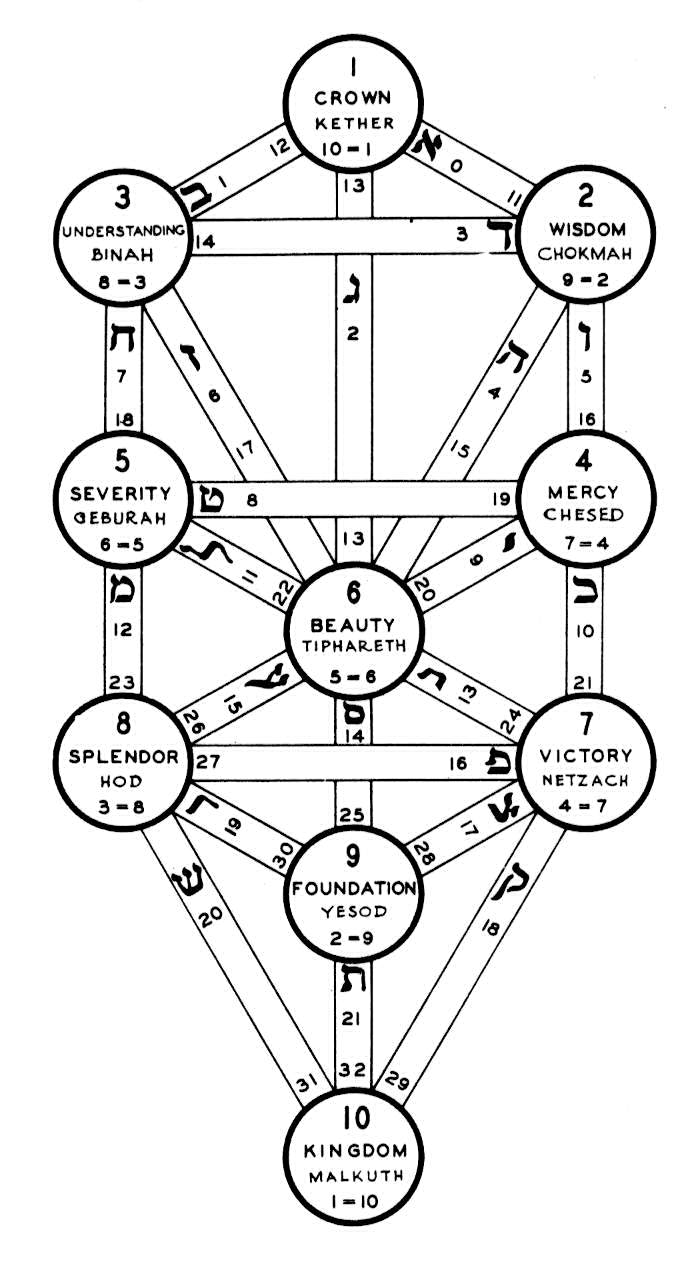
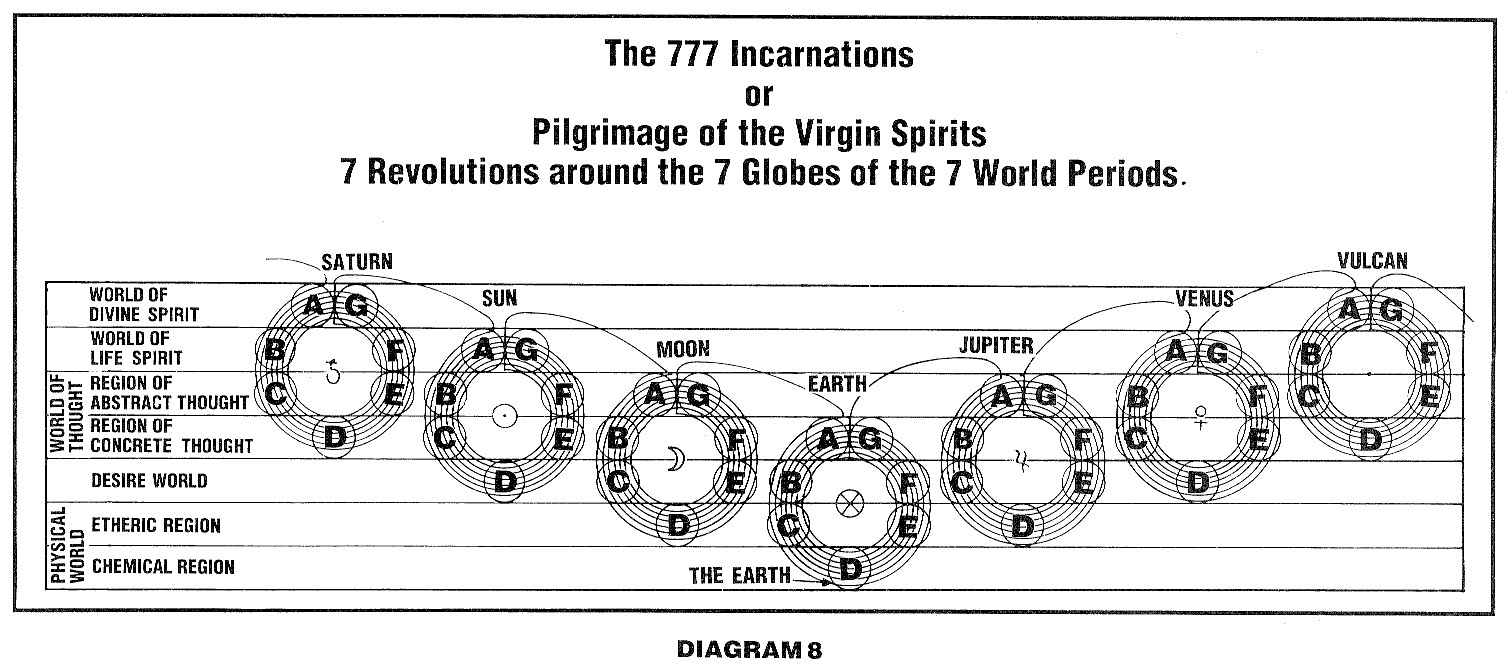
There is, in every Mystery Temple on the inner planes, a "seat" or place reserved for each individual who belongs to that Temple; for this is a membership which goes back to the primeval sources of our solar system, when the life wave of human spirits, called virgin spirits, came forth fresh from the hand of God before they had run the cycle of involution. There are seven great "Rays" or streams of life, and each one is governed by a "Father Star." Then are seven Mystery Schools in which the Nine Lesser Mysteries are given, and each school is governed by one of these seven Father Stars, and its members are all fellow-spirits who came forth from that Star in the beginning. Therefore each individual has a seat with his "name" written upon it in one particular Mystery Temple; but the Seige Perilous is the throne of the Master of the Temple.
After Galahad had been introduced to the Court, King Arthur took him down to the river and showed him the red stone floating with sword thrust deep therein, and Galahad withdrew the sword with ease and put it in the sheath that hung empty at his side, which it fitted perfectly. And he said: "This is the enchanted sword which was Sir Balin's wherewith he slew by mistake his Brother Balan, who also slew him at the same time; and through him came the dolorous wound to my grandsire King Pelles, which is not yet whole, nor shall be till I heal him."
In these cryptic utterances Galahad reveals his mission to heal the disunion between the outer, or exoteric and orthodox Church, and the inner, or esoteric, Mystery Temple. Already in this early day a growing materialism was causing the churches in the West to reject and to persecute the true esoteric Temple and its Teachings. It is significant that King Arthur and all his Court are perfectly well aware that the Castle of Carbonek is the stronghold where the Grail is to be found, if it is to be found at all; yet it is invisible to all eyes since the sin of Amfortas, or King Pelles. In the Galahad legend it is Sir Balin Le Savauge who inflicts the wound; and this knight, as well as his brother, is actually a knight of King Arthur's Court, so that "three counties" are disrupted by his crime. For when he has attacked King Pelles, lightning strikes the Castle of Carbonek, and the whole countryside is devastated by famine, plague and natural cataclysms. The two brothers, Sir Balin and Sir Balan, also suffer the karma of this condition when they meet in a battle, with visors down, and slay one another, discovering their identities only after each has dealt the other a mortal wound, and they die with arms twined remorsefully and lovingly about one another.
Occultists know that the life man lives reflects itself in nature. Violent passions react in destructive fires; unbridled emotions in floods; deceptions and double-dealing in blight and mildew of crops; anger, resentment, sarcasm in biting and stinging insects. Only man himself can create conditions favorable to a new heaven and a new earth, which must come from within before it is established firmly without. It is such interior soul conditions, reflected through King Arthur's Court, which bring about its dissolution.
As King Arthur and Galahad and the company of knights stood on the river bank, Galahad with the sword taken from the stone, a lady came riding on a white palfrey and said to the King that Nacien (Nathan) the Hermit had sent word to the King that on this day the Holy Grail should appear in his house, and then she returned whence she had come.
And the King said, "Now I know that the Quest of the Grail shall begin, and all ye will be scattered so that nevermore shall I see ye again as ye are now; let me then see a joust and tournament amongst ye for the last time."
The tournament was held in the meadows outside Camelot, with the Queen and the other ladies of the Court watching from a tower. In this tournament, Galahad had no shield and wore only light armor and a helmet, yet in a short time he outfought all but Sir Lancelot and Sir Percival, after which they all went to evensong in the great minster and then to supper in the great hall.
And as they sat at a table, there was heard a great thunder, and in a flash of light the Holy Grail entered the hall not borne by hands, but appearing steadfast in the beam of light, covered with white samite, and at its appearing each person in the hall was miraculously fed with that soul food which most he delighted to have, whatever it might be, and then the Grail, having traversed the hall, disappeared as it had come, with suddenness.
And at once, upon its disappearance, impetuously Gawain leaped to his feet and announced that he would go in Quest of the Grail, and the others eagerly followed him in their vows. Arthur, with tears in his eyes, spoke: "Sir Gawain, Sir Gawain, thou hast set me in great sorrow, for I fear me my true fellowship shall never meet together here again; and surely never Christian king had such a company of worthy knights around his table at one time."
This he said, knowing that it was only the Knight of spotless purity and valor who was destined for the Quest of the Grail and that only he who sat in the Siege Perilous could achieve it. Such, then, were the marvels of Galahad's coming and the foolishness of Gawain whose example set the whole Court aflame and brought to an end the glory of the King.
Now let us examine what has been revealed in this account of the true nature of the Holy Grail and the meaning of its Quest.
Only one knight among them all is destined for success, and this is Sir Galahad. The King will not go forth upon the Quest, for he knows that his work lies near at hand, which God called him to do in the beginning, and this he will continue to do until the end.
The knights of his Court, however, show themselves wanting in a sense of responsibility; they are rash and unrealistic of outlook. It is a maxim of the initiatory Path that when the call to seek the Light comes to any person, it comes in just those conditions that are right for him, however burdensome they may seem to be. Is a man called who has wife and children to support? Is a wife called whose family makes demands upon her strength and time? Is the workman called whose hours are passed in hard manual labor? Or the craftsman, or the teacher, or the law-giver, or the soldier whose days are at the command of others? Whatever the condition may be, the aspirant will never find the Light by tearing himself away from his duties and responsibilities. When he is ready, the Light, the Grail, will find him wherever he is, and as it fed the knights at King Arthur's Court, so it will feed, with all that is necessary to the day and the way, every person who seeks it with dedicated heart and with a mind set firmly and one-pointedly in the direction of the lodestar of Truth.
But even the Predestined One, the Ambassador of Spirit, must first prove himself in the trials of daily living before the Grail will reveal itself to him.
The initiatory Path traverses both heights and depths. It is a way of light, yet it has its valleys of shadow, as it leads upward to the supernal peaks of cosmic illumination. In the life of the Great Exemplar the glories of the Transfiguration were followed by Gethsemane and Golgotha, and these again by the Resurrection and Ascension. The height of spiritual ecstasy must always descend into the valley of the common and the restricted, in which the understanding gained in the high place is put to the test.
Reference has been made previously to the part played by women in the Grail legends. Each knight took oath that he would choose but one maiden and remain faithful to her throughout life. We have also shown that the feminine principle, when linked with the lower desire nature, is the cause of all failure, but when linked with Spirit leads to success in the Quest. The Will and Reason, masculine principles of the human spirit, must guide and direct; Imagination and Love, the feminine principles of God, the Shekinah, or Glory, are called the Presence of God.
The purity, moral strength and mental illumination of the young Galahad could only attract that which was as pure and beautiful as himself. He met and loved a maiden by name Blanchefleur, or White Flower, but he does not take her in marriage at this time.
Like Parsifal he proceeds to the Castle of the Grail, which is Carbonek, his grandsire's citadel, and sees the Grail Procession, but fails to ask the fated question. He has indeed arrived at his goal; he sees the Procession of the Mysteries which King Pelles, his son Eleazar and the Court are not able to see, and he is baffled to find that the spell which holds the castle and its inmates in thralldom remains unbroken.
He finds King Pelles worn by suffering, tossing uneasily upon a couch in a sort of waking sleep. Upon the entire court, its knights, ladies and priests, the same dream-like spell is evident. This dream-like state signifies the stupor of materialism into which all mankind has fallen through misuse of the Love Power which has meant the loss of the Holy Grail. Conservation of the life force is necessary to spiritual awakening, in which all evil and suffering vanishes like a dream of the night.
They all, both men and women, knights and priests, feel intuitively the blessed release which the pure good knight has power to bring to the Castle.
As Galahad stands beside the sleeping King, almost overcome at the thought of the work that lies before him, he sees the wonderful procession of the Grail passing nearby, which Pelles and his Court are now to chill and insensate to behold. "Only the pure in heart can see God." Only the pure can witness the visitation of angels who are so often with us as counsellors and inspiration.
Galahad sees the Angel of the Presence. He sees two knights, each with a seven-branched candlestick, another knight who holds aloft the bleeding spear and a maiden with a golden dish-the contrary symbol of Herodias, who carried the head of John the Baptist and used it for purposes of black magic. Here the Dish is sacred to the Christ. Power used either for good or evil is the same power, and power as such is not evil.
But like Parsifal, Galahad must return to the world, departing from the Castle of the Grail to perform some needed service, to amend some fault or shortcoming and so to gain the wisdom and compassion which will enable him to ask the fated question.
The mystic possesses faith; he knows intuitively what Truth and Goodness mean, but he does not possess understanding. It is the blending of two things-faith, or intuition, with under standing — that is Wisdom. It has been said that Wisdom is crystallized pain. This is virtually the universal experience, for men will learn no otherwise than through sorrow and suffering. Therefore the Way is long and hard, and for each one the achievement of the Quest is long deferred. Many lifetimes are spent in its pursuit. Through disappointment, heartache, dis illusionment, the light may sometimes seem no more than a phantasm of the night, and only he who is persistent and patient will follow Galahad to the end of the Quest.
In Galahad's life the failure came when he did not marry Blanchefleur, who was his predestined wife, for in the Kingship of the Grail a certain maiden was sent to earth to rule with a certain King, and the King must marry and live a chaste life of Christian love, leaving a son to rule after him. This is not a dynasty of celibates, as in the Church.
Just before Galahad departed on his journey to the Castle of the Holy Grail, Percival's sister makes a belt for Galahad's sword with her own hands: "The wan sweet maiden clean from her forehead sheared away all that wealth of hair which made a silken network for her feet, and out of that she plaited, broad and long, a strong sword belt, and wove with silver thread and crimson in the belt a strange device, a crimson Grail within a silver beam." Binding the belt about Galahad she said:
In esoteric symbology, the hair from which the maiden weaves the sword-belt represents the vital principle; hence its importance in all so-called magical rituals and practices of the black arts. The girdle signifies the protecting aura of the mind which is fixed on spiritual things: the engirdling "wedding garment" of the two higher ethers which enhalo the soul body.
Galahad must therefore retrace his path, fulfill certain labors, come once more to Blanchefleur, and enter into marriage with her, after which he will complete the Holy Quest and accomplish his mission.
Having gone forth into the wilderness of the world once more, Galahad takes up those labors of the soul which every aspirant must perform on the way to the Grail and to the Spiritual City.
In the valley below Camelot, he came upon his first adventure, the encounter with the Loathly Damsel and her two companions. Here for the first time he learns why he failed at the Castle of the Grail. Bitterly the Damsel reveals to him his fault, and shows him that he should have made question of the conditions he found there.
The three maidens typify the three personality-principles of man: the physical, the etheric and the astral, or desire, body. It is Desire which is the dominant power of these three corporeal principles. All three are garbed in dark apparel. The second maiden carries a lash with which she drives forward the steeds of the other two. The Lovely Damsel was once a beautiful maiden, but now her countenance is distorted with evil passions. She is the counterpart of Kundry in Wagner's Parsifal.
Modern mental science is rediscovering the part which thought and emotion play in the health and beauty of the physical body. Envy, hatred, malice, every sort of evil emotion and every sort of evil thought leaves its mark in the organs of the body. The Loathly Maiden hurled fierce invective against Galahad, blaming him for her lowly and degraded condition. Galahad sorrowfully admitted that this was true, realizing, as every aspirant must in moments of self-revelation, that he is himself responsible for the loathsome images which drive through his imagination and emotions, at least in the passive sense of permitting them entry from without.
Later, when Galahad has attained the powers of the Holy Grail, the Loathly Damsel is made wholesome and beautiful again. Her transformation is symbolic of the awakening of the Divine within every human being, whose awakening causes him to manifest the beauty and wisdom which are his supernatural heritage.
Galahad's next adventure was to meet in mortal combat seven evil brothers, the seven deadly sins of the Christian neophyte. They are encased in dark grey armor, and they stand guard over a castle in which are imprisoned seven beautiful and holy maidens. Galahad met these seven brothers in combat one by one, and overcame them all.
The seven deadly sins are envy, sloth, lust, anger, gluttony, pride and avarice. Until the aspirant has made some progress toward eradicating these seven deadly sins, he cannot advance very far upon the Path of Attainment. The gray armor points to the grey and dark colors shown in the aura of the person who is still subject to these sins, for fear in one form or another attends upon them all, and grey in the aura is the significator of fear.
After Galahad's conquest of the seven brothers, an old man appeared who gave him a key to the castle wherewith to liberate the seven lovely maidens. This key is self-control. The old man is again the Wise Man, the Magus, Gurnemanz, who represents Wisdom, the Wisdom which Galahad has won through the over coming of the seven evil brothers, or sins, which then made it possible for him to acquire their corresponding virtues and powers.
There are seven important spiritual centers largely dormant within the auric envelope of every individual, which can be awakened only by means of spiritual development. These are the seven lovely maidens imprisoned in the castle by the dark brothers. So long as the aspirant is dominated by the seven sins, the powers lie dormant, sleeping, awaiting the coming of their emancipator. When Galahad enters the castle, the maidens, arrayed in beautiful colors, rush forward to greet him with great joy. These colors are again auric significators, a certain color characterizing each of the centers, which ray forth in the aura and produce magnificent spectacles visible to the clairvoyant. Clairvoyance, clairaudience, ability to function apart from the body at will, conscious Invisible Helpership and other spiritual powers accompany the awakening of these vortices.
Liberating the souls in purgatory is not the work of Christ alone, nor yet of archpriests. Every Invisible Helper spends at least a portion of his time, when apart from the body, in exploring the purgatorial region and doing what he can to help the souls there, instructing them in the true nature of the spiritual worlds and aiding them to learn their lessons so that they can rise more speedily from their sorrows into the beauty and bliss of heaven.
The Maiden's Castle in the Inner World, the center of life; the outer world is the world of death. The dead are the truly living; those we call the living are in truth the dead. So long as the quest of things supersedes the quest of Spirit, so long as man lives in the separative consciousness of "me and mine" and devil take the hindmost, he is living in the death-consciousness and not in life. All are refreshed and encouraged by the coming of Galahad. This is the purpose of the life and work of one who is an Ambassador of Spirit.
Now at last Galahad returns to Blanchefleur, the White Flower, and marries her, and the next morning he sets out again for the Castle of the Holy Grail, completing the labors which it is his destiny to perform.
This incident signifies the sacrifice of the personal life to the life of service, which is undoubtedly the most difficult initiatory test of all, but one that each must meet in some life upon the Way of true attainment.
The high and holy purpose of Galahad's marriage to Blanche fleur leaves no room for personal sorrow, since in this union Galahad goes forward to complete the Quest with the masculine and feminine united within himself.
Arriving the second time at Carbonek, Galahad finds there Sir Percival and Sir Bors and nine other knights, three from Gaul, three from Ireland and three from Denmark. This time Galahad does not fail to ask the question which is to release the Castle from its spell.
King Pelles and his son are sent away, and when they have departed, Galahad sees four angels descend from heaven, carrying a chair in which is seated his ancester, Joseph of Arimathea, "the first Bishop of Christendom," whom the four angels set before the silver table on which the Grail stands. Then the door opens and again four angels enter, two bearing waxen candles, the third a towel and the fourth a bleeding spear which drips into a box which the angel holds in his other hand. The angels places the sacred objects on the table with the Grail, then Joseph takes the bread to serve Mass, and Galahad sees the image of a child smite itself into the bread, which Joseph puts into the Cup. And after the knights have given one another the kiss of peace, they are all fed from the Grail; but Joseph vanishes away. Even so is the Grail Feast served to every disciple on a silver platter just when the time is most opportune.
As the knights sat at the holy table in dread, they "saw a man come out of the holy vessel that had all the signs of the passion of Jesus Christ bleeding all openly, and said, "My knights and my servants and my true children, which be come out of deadly life into spiritual life, I will now no longer hide myself from you, but ye shall see now a part of my secrets and of my hidden things." The Christ then ministered to Galahad and the knights as he had ministered to the disciples at the Last Supper, after which He said that the land had grown evil and the Grail must be taken away to Sarras once more, to the spiritual place, and that Galahad must take it there. But first he is to "take of the blood of this spear for to anoint the mained king, both his legs and all his body, and he shall have his health."
What is the question which Galahad must ask? It concerns the mystery of the Sacred Four Letters, the Tetragrammaton, which stands in the place of the Ineffable Name of God. These four letters are the four cosmic roots of creation. They signify the four mystical elements, Fire, Earth, Air and Water, and their working for the union which produces the cosmos. St. John says that "the Word was made flesh" in Christ Jesus, and this is also implicit in the Grail story, for both in Malory's Marte d' A rthnr and in the High History of the Holy Crail the Christ is seen to rise up out of the Cup which has been blessed by the mighty Hierophant Joseph of Arimathea. It is then The Grail Himself who sends Galahad and his two companions to Sarras, the Holy City.
When we turn to Wagner's Parsifal we find that Parsifal anticipates the true question when he asks, "Who Is The Grail?" and Gurnemanz replies:
The Mass of the Grail (Initiation) being done, Galahad takes the spear to heal King Pelles, and King Evelake, still living after three centuries, kisses his descendant and successor and ascends to heaven. Joseph of Arimathea is Galahad's teacher as well as his spiritual ancestor, for in all Mystery Schools the time comes when the Teacher calls his disciple "Son," even though there may be no blood relationship whatever. The veil which has hidden the mysteries of life is the same as the Veil of Isis, whose mysteries are always hidden from the profane and revealed to the pure in heart.
Life and light now break forth from the Grail, awakening and vitalizing all who dwell within the Castle and the Court. The King, priests, knights and ladies are nourished with the wondrous substance of the Grail and made whole; which means that the earth and its humanity are regenerated and redeemed through pure and holy living and the building of the power of the Holy Grail within — a power which is the true atomic force.
Galahad bends in affection above the dying King; the eyes of King Pelles are lifted to behold the Grail, and seeing, he receives blessed comfort and release from pain and suffering.
King Pelles (or Amfortas) signifies our present earth humanity, which lives amid suffering and limitations caused by the misuse of the sacred life forces. Galahad represents the pioneers of the new race, living and teaching the way to regeneration through purity.
The three Knights from Arthur's Court are instructed to take the Grail and Spear to Sarras, for a ship awaits them in the harbor below the Castle. As they ride forth the countryside is smiling and serene, crops flourish, men and women are happy and smiling; for the curse has departed from the land.
The knights are taken in a small boat to the ship, on whose sails they see the sign of the Red Cross, and in the ship awaiting them is the silver table, and on the table the Grail covered with red samite; and a great and splendid bed on which Galahad should sleep, called Solomon's Bed. For this was the ship called Solomon's Ship, of which many wondrous things were told.
When Solomon built this ship he foretold that it was to be used by one of his line, a man who should be also a maid, and that it should bear him to the holy city of Sarras. In the wonderful vessel Solomon placed a bed with a crown upon it, and at its foot the sword of David of the line of Judah. The bed was enclosed by a frame composed of two rods rising perpendicularly from the center of each side and crossed by a third above. These three rods are of three symbolic colors, white for chastity, green for compassion and long suffering, and red for charity. They come from the Tree of Life and have undergone three changes in color corresponding to the primeval innocence, the fall, and the redemption. In the three rods we have a reference to the right-angled triangle which was an important measuring device to ancient builders and which remains symbolic of the builder's mysteries in Masonry today. It is the Pythagorean Triangle of the Greek Mysteries and possesses profound philosophical meanings far beyond the mere mathematical usage.
Solomon's Ship means divine Wisdom through which the soul body is built. That it is Solomon's Ship in which Galahad is to sail reveals a mystery: namely, that Solomon was the founder of the kabbalistic School which is figured in the Grail. Solomon's name means "Wisdom of the Sun." The Ship's colors were also Galahad's colors, white for stainless purity, green for compassion and long suffering, red for the love power and light of the Holy Spirit which went ever with him.
In all Grail legends the inner meaning parallels the outer, so that each meaning may be read separately or together with the other; and while the outer legend is poetic and touches the heart, the inner is a discipline for the mind and spirit. Thus in all esotericism spiritual teachers use the symbolism of the ship to indicate the "soul body" or "celestial body," as Paul describes it, in which the illumined one rises into the angelic realms. For among esotericists it is well known that the soul is not a mere cloud or formless gust of wind, but that the human ego, wherever it may be, tends to put forth some sort of embodiment as a plant puts forth blossoms, and this phychical body "sails," as it were,, in an aura of light. Hence in Scriptures and Apocrypha "boats" and "ships" point to events which happen in the soul world, either when the "terrestrial" (physical) body is asleep or when the ego has withdrawn from it into its "psychical" or celestial body in some initiatory rite, sailing aloft in its auric vessel.
The new Christed Initiation, which was just received by Lazarus, differed from the ancient form in that due to a higher stage of unfoldment the former trance conditions was no longer necessary for the new Christed Initiation. The Initiation belonging to the new Christed Dispensation is received in full waking consciousness, using neither hypnosis nor drugs.
The Initiation of Lazarus was therefore not the trance state of antiquity but the conquest of death itself and the inauguration upon earth of a new initiatory method.
The "New Jerusalem," or City of the Holy Grail, is not the mere physical city of wood and stone. It is a Mystery Temple located in the etheric realms high over its physical counterpart, which in its present condition is truly a distorted shadow of the spiritual archetype which glitters above it like a crown (or "island"). Here to this day the Lord Christ, the blessed Mary, the disciples and the holy men and women who created the early Christian community continue to meet and work with those yet living on earth, if they are sufficiently advanced to come to them there.
Many beautiful stories of the early Christian Church show with what eagerness the "followers of the Way" looked to each Sun's Day, which they adopted instead of Saturn's day of the Old Dispensation. Some indeed could visit the initiatory halls in full waking consciousness; others remembered as a dream what there they had known and seen. Still others brought back only a sense of radiant happiness, with no clear memory of its source, though they divined its cause. St. John's experience in this Holy City he has incorporated in the Book of Revelation, which, though it is an allegory, is more than allegory in that it conveys under poetic similitudes a hint of conditions that have real existence in the soul world.
When Galahad entered the holy place he was received with great rejoicing. The Master truly stated when He was with men on earth that there is more rejoicing over one lamb that has been found than over the ninety-nine safe in the fold. So also there is great joy among the Emancipated Ones when one who still lives in the dark body of earth learns to sever the bonds and soars, freed from his chains, to work at will in the cosmic fields of the higher realms. It is here that Galahad comes to stand before the Tree of Life laden with golden fruits, which are the rewards of transmutation of the seven deadly sins into powers of the spirit: Faith, Hope, Love, Compassion, Service and Universality.
Galahad now joins those Emancipated Ones whom St. John describes in Revelation as standing upon the Sea of Glass and bearing the Name of the Lamb on their foreheads. He has claimed for his own the most glorious heritage which man, while living upon this earth, can ever know: the first-hand experience of conscious immortality; for, as the poet sings, he has found "a life beyond this life."
St. John states that the leaves of the Tree of Life, which are green and signify the knowledge of inner plane mysteries, are for the healing of the nations. Such is the exalted state achieved by Sir Galahad, who is the perfect type pattern of the Christed man of the New Age, in whom we see as in a glass the image of what the New Age man shall be in the plenitude of his powers. This is not something limited to the members of a single cult or sect; it is the promised pattern for the entire human race. Here Sir Galahad is, in himself, the symbol of the 144,000 "saved" — a kabbalistic cipher signifying all mankind as Adam's seed.
In these turbulent days filled with fear, suspicion, wars and rumors of wars, it is well that as modern aspirants upon the Way we lift minds and hearts in daily prayer, contemplating the fair bright day which awaits all humankind.
— Corinne Heline
|

|
|
|
|
Contemporary Mystic Christianity |
|
This web page has been edited and/or excerpted from reference material, has been modified from its original version, and is in conformance with the web host's Members Terms & Conditions. This website is offered to the public by students of The Rosicrucian Teachings, and has no official affiliation with any organization. | Mobile Version | |
|